Call Now:
1300 247 066Australia's #1 Food Trailer Supplier
Click Here For More Information
Scroll Down For Further Information
Call Now:
1300 247 066Australia's #1 Food Trailer Supplier
Scroll Down For Further Information

One of the most common questions people ask when starting a mobile food business is:
“What size food trailer do I actually need?”
Choosing the right size trailer is important because it affects:
Your menu options
Your startup costs
Your workflow and efficiency
Where you can trade and operate
Go too small and you may struggle with space.
Go too large and you may spend more than necessary.
In this guide, we’ll walk through the most common food trailer sizes and how to choose the right one for your business.
Your food trailer size determines how comfortably you can operate and how much equipment you can install.
Larger trailers provide:
More working space
Room for additional cooking equipment
Faster service during busy periods
Smaller trailers provide:
Lower startup costs
Easier towing and transport
Access to tighter event locations
If you’re still researching trailers, our The Complete Guide to Buying a Food Trailer in Australia (What Most People Miss) explains the key things to consider before choosing a trailer.
Most mobile food businesses operate with trailers between 8ft and 12ft.
Each size suits different types of menus and operating styles.
8ft trailers are usually the most compact and affordable option.
They work best for simpler menus such as:
Coffee and drinks
Desserts
Ice cream
Simple takeaway foods
Benefits include:
Lower purchase price
Easy towing
Great for markets and small events
However, space is limited, which can make larger menus difficult to operate efficiently.
If you’re planning a smaller startup, it’s also worth reading How Much Does It Cost to Start a Food Trailer Business in Australia?, which explains how trailer size impacts overall startup costs.
For many operators, 10ft trailers are the most popular choice.
They provide a balance between:
workspace
equipment capacity
mobility
A 10ft trailer can comfortably support menus like:
burgers and fries
street food
loaded fries
tacos
wraps
coffee plus hot food
This size also works well for two-person teams, which is common for couples or family-run businesses.
If you’re considering running a trailer together, our article Is a Food Trailer a Smart Move for Couples or Families? explores how many operators successfully run food trailers as a team.
12ft trailers are better suited for high-volume trading and larger menus.
These trailers often include:
multiple cooking stations
additional refrigeration
larger preparation areas
They are ideal for businesses planning to operate at:
large festivals
busy events
catering functions
Our article Why Food Trailers Are Ideal for Events, Catering & Markets explains why many operators choose larger setups when focusing on high-volume trading.
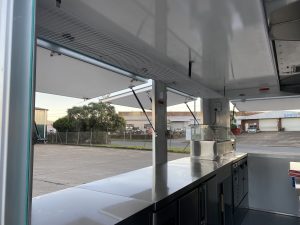
Your menu is often the biggest factor in determining the right trailer size.
For example:
Coffee or dessert menus
Usually fit comfortably in an 8ft trailer
Street food menus
Often require a 10ft trailer for grills, fryers, and prep space
Full hot food kitchens
May require a 12ft trailer or larger
Thinking about your equipment needs early will help you avoid overcrowding your workspace.
Larger trailers usually require:
More equipment
Larger power systems
Additional refrigeration
This naturally increases the total startup cost.
If you’re comparing different options, you can view our Food Trailer Price List to get an idea of pricing across different trailer sizes.
Understanding pricing early helps you plan your investment and choose a trailer that fits your business goals.
Another factor people overlook is where the trailer will operate.
Smaller trailers can:
Fit into tighter market spaces
Be easier to tow
Access residential streets for catering jobs
Larger trailers are better suited for:
large festivals
high-capacity events
long-term event setups
Many operators start with a smaller trailer and upgrade once their business grows.
The best food trailer size depends on:
your menu
your team size
your trading locations
your budget
For many new operators, a 10ft trailer offers the best balance between space, flexibility, and cost.
However, every business is different, and choosing the right setup from the beginning can make a big difference to your daily workflow.
Starting a food trailer business involves many decisions, and choosing the right trailer size is one of the most important.
A well-sized trailer allows you to:
work comfortably
serve customers efficiently
scale your business over time
If you’re researching mobile food businesses, you might also find it helpful to read How Much Do Food Truck Owners Really Make? The Viral Video That Has Everyone Talking, which looks at the income potential in this industry.
For more information, full pricing and package options, register here‘
or contact us here
For further information about our range of products and prices, please enter your details in the form below to get access to instant pricing and the opportunity to have the information package posted out to you
